



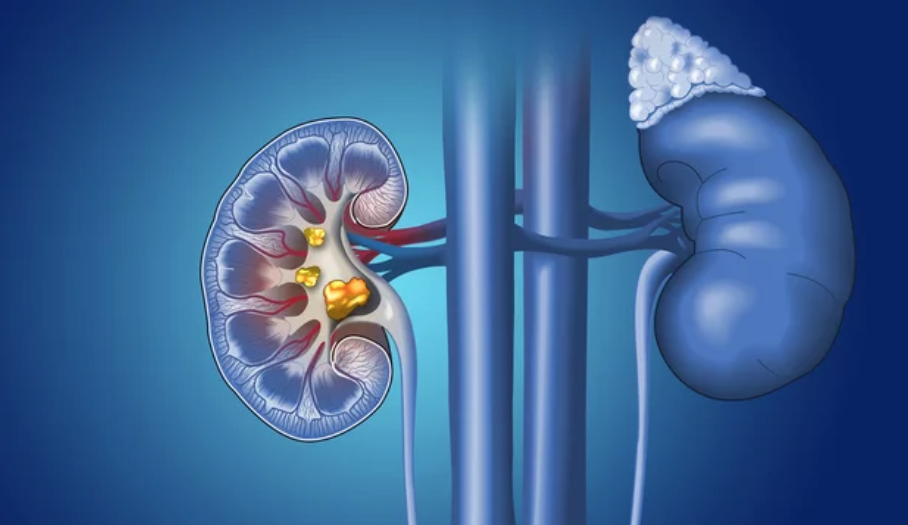
Kidney stones, also known as nephrolithiasis or renal lithiasis in medical parlance, are small aggregations of mineral salts that develop in the kidneys. These formations, often referred to as “pebbles,” originate from the crystallization and accumulation of certain substances normally found in urine.
Indice
Kidney stones: what are they and how do they form?
Kidney stones are hard deposits consisting of different substances, particularly calcium oxalate, calcium phosphate, and uric acid. These substances, normally present in solution, can crystallize to form stones if their concentration is too high or if the fluid in which they are dissolved is low (i.e., in the case of urine that is too concentrated).
Over time, stones tend to move from the upper urinary tract, where they are formed, to the lower urinary tract, passing through the ureter to the bladder, and finally to the urethra, where they can be expelled during urination. When stones leave the kidney and are found anywhere in the urinary tract, the medical definition becomes urolithiasis or urinary stones.
Kidney stones are very common: an estimated 100,000 new cases per year in Italy, with a higher frequency in southern regions.
Kidney stones: why do they form?
Risk factors for kidney stone formation:
- Drink little: water, in fact, prevents stone-forming substances from crystallizing and aggregating to form “pebbles.” It is important to keep in mind that in the case of kidney stones it is important to drink plenty of water, but in the presence of renal colic, it may be dangerous to take too much water because of the risk of creating excessive pressure at the renal level
- Climate: high outdoor temperatures have been shown to increase the risk of kidney stone formation
- Intense exercise: If fluids lost through sweating are not replenished, you run the risk of having overly concentrated urine
- Poor diet: high-protein diets low in fruits and vegetables or high consumption of sugary drinks
- Obesity and sedentary lifestyle
- Familiarity: there is ample evidence that family history plays a very important role. In fact, you are more likely to suffer from kidney stones if other family members have also suffered from it in the past

Symptoms and consequences: renal colic
Kidney stones form in the kidneys and are usually asymptomatic unless they reach a significant size.
However, the stone may move from the kidney and descend into the ureter, a thin tube that connects the kidney to the bladder. In this case, displacement of the stone and eventual obstruction of the passage of urine lead to the onset of renal colic.
The renal colic is characterized by a sudden, stabbing pain in the lower back or abdomen, described as a “stab wound.” The symptoms of colic are so violent that they often require a visit to the emergency room.
Diagnosis and treatment
If renal colic is present, an ultrasound of the abdomen or a CT scan is performed to best identify the stones and assess: their location, size, and degree of hardness.
Based on the type of kidney stone, a decision is made whether and how to intervene:
- Large stone causing major obstruction: action is taken by inserting a catheter between the kidney and bladder so as to “bypass” the stone and avoid renal blockage.
- Large stone but not causing obstruction: urologic endoscopy techniques are used. In this case, one enters with the endoscope from the urethra and pulverizes the stone in place and then aspirates it.
- Small calculus (less than 1 centimeter in diameter) and no complications: usually the patient is expected to excrete it independently through urine within a few days.
- If the patient does not spontaneously eliminate the stone, extracorporeal shock wave lithotripsy can be used. This procedure acts from the outside via shock waves and fragments the stone, facilitating its exit.
Prevention of kidney stones
After the stone has been eliminated, a metabolic evaluation is necessary to understand its composition: in fact, every person always produces stones of the same type. Knowing the type of stone that has been eliminated allows different dietary and therapeutic directions to be given, depending on whether these “pebbles” contain calcium oxalate (the most common), calcium phosphate, uric acid, or cystine.
In many cases it is necessary to change the acidity of the urine: urine that is too acidic actually promotes stone formation.
To alkalize urine (i.e., reduce its acidity) citrates are of utmost importance.
The role of citrates in stone prevention
Citrates, usually magnesium citrate and potassium citrate, are salts that play a key role in the prevention and treatment of kidney stones.
Citrates have two main actions:
- They reduce the acidity of urine due to their alkaline characteristics. Less acidic urine allows solubilization of uric crystals, preventing aggregation and stone formation.
- act on calcium oxalate and calcium phosphate stones by transforming them into the solubilized form due to their ability to bind and sequester Calcium.
Potassium-magnesium citrate: the innovation of combined salt
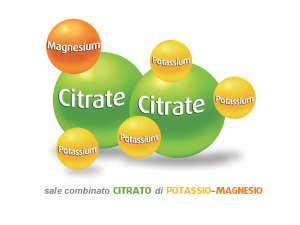
The potassium-magnesium citrate is a combined salt in a single formula, unlike common mixtures of potassium citrate and magnesium citrate. This particular salt complex contains higher amounts of citrate, resulting in more effective treatment and prevention of kidney stones.
In addition, this innovative combination salt contains magnesium and potassium in the optimal ratios to properly maintain the functions of the muscles, heart, and nervous system.
The combined Potassium-Magnesium salt has good solubility, pleasant taste, and excellent gastro-intestinal tolerability.
SolvhoRen sachets
Helps you prevent kidney stone formation with its potassium-magnesium citrate formulation
Citrates are not the only tool at our disposal to prevent the formation of kidney stones and promote their expulsion.
In addition to acting at the chemical level with Potassium-Magnesium citrate, we can in fact intervene at the biological level with Phyllanthus extract, which is able to limit the growth and aggregation of oxalate crystals.
Phyllanthus, the “stone-breaking” grass.
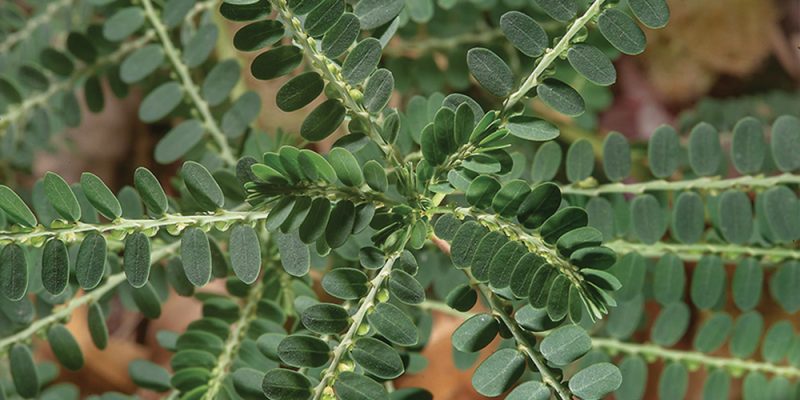
The Fillanto (Phyllantus niruri) is a typical South American plant also known by its Peruvian name “Chanca Piedra,” meaning “stone breaker“, “destroyer of stones.”
The extract that is obtained from the flowers and leaves of this plant is rich in tannins and has an important activity: it can counteract lithiasis.
Activity of phyllanthus against kidney stones:
- Counteracts the formation and aggregation of kidney stones because it increases the solubility of alkaline salts
- Helps maintain low bacterial counts in the urogenital tract
- promotes the expulsion of stones and kidney stones (kidney sand) because it exerts relaxing activity on the smooth muscles of the urogenital tract
The results of clinical trials have shown that phyllo has good therapeutic potential since it is able to change the consistency and structure of the stone making it more friable and thus more easily broken down and eliminated by urine.