




PEA (Palmitoylethanolamide) is a physiological substance that has been shown to significantly reduce the abdominal pain component in patients with Irritable Bowel Syndrome.
Indice
What is Irritable Bowel Syndrome?
Irritable Bowel Syndrome or IBS is a chronic intestinal condition, often highly debilitating, whose causes are not yet clear, not associated with organic or inflammatory alterations.
Patients generally complain of: abdominal pain and bloating associated with frequent diarrhea, or prolonged constipation, often in periodic alternation, relief of symptoms after defecation
The management of chronic abdominal pain represents one of the most problematic aspects of this syndrome. In fact, the use of common painkillers cannot be continued for long periods due to the possible side effects typical of these active ingredients.
This particular situation has focused the attention of clinicians and researchers on a physiological molecule, normally produced in case of need by some cells of our organism: Palmitoylethanolamide (PEA).
Palmitoylethanolamide (PEA): what it is and how it acts
Palmitoylethanolamide (PEA) is a substance of natural origin with an interesting history. Discovered in the 1950s, this molecule was rediscovered and gained notoriety thanks to the pioneering work of Nobel laureate Rita Levi Montalcini in 1993. It was she who revealed its complex mechanism of action, opening the way to new therapeutic applications.
From a chemical point of view, PEA is one of the most common saturated fatty acids in both animals and plants. Its name derives from the fact that it was initially identified in palm oil, but it is also found in foods such as milk and dairy products, soybeans, peanuts and many others.
PEA has proven effective in the treatment of both acute and chronic pain syndromes, and this is due to several mechanisms:
- Similar to painkillers: PEA acts in a similar way to the most common painkilling drugs on the market, known as NSAIDs (Non-Steroidal Anti-Inflammatory Drugs). This makes it a powerful option for pain relief.
- Mast cell control: PEA regulates the activation of mast cells, cells present in the connective tissue, especially in the pelvic-abdominal region, which are activated in case of inflammation. This control of inflammation is essential for relieving pain.
- Interaction with cannabinoid receptors: PEA is able to interact physiologically with the body’s cannabinoid receptors. This interaction further contributes to its high pain-relieving power.
In summary, PEA represents a promising option for the treatment of pain, thanks to its multifunctional mechanisms of action and its natural origin.
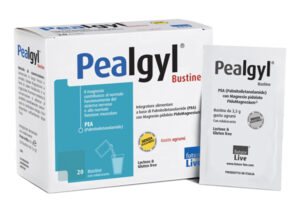
Pealgyl
Based on PEA and Magnesium Pidolate, it can be useful to guarantee relief and relaxation from abdominal pain caused by Irritable Bowel Syndrome
Clinical studies on PEA and Irritable Bowel Syndrome
A recent clinical study has shown how PEA is able to significantly reduce the abdominal pain component in patients with IBS.
54 patients suffering from Irritable Bowel Syndrome (IBS) were divided into two groups.
The first group was administered PEA with an antioxidant while the second group received a placebo.
At the end of the study period, the group that received PEA showed a statistically significant decrease in the intensity of abdominal pain compared to the placebo group.
PEA and Magnesium pidolate
An interesting development of the application of PEA in the control of pain symptoms related to irritable bowel is represented by its association with Magnesium pidolate.
Magnesium pidolate is a particular, extremely bioavailable organic salt, which is able to exert a significant muscle-relaxing effect on the abdominal smooth muscle.
The association of PEA + Magnesium pidolate therefore allows with a single product (Pealgyl – Future Live) to exert a double control on abdominal pain symptoms.
Tolerability and safety
Since PEA is a physiological substance normally produced by our cells, it can be administered even for long periods and to all subjects without incurring the risk of any unwanted side effects.
If necessary, it can also be associated with other active ingredients should there be a need, without risks of possible interactions.