




Potassium-Magnesium Citrate
Citrates are salts of citric acid that are filtered by the kidneys and expelled through the urine.
A condition of low urinary citrate is a major risk factor for the formation of kidney stones composed of calcium salts, particularly calcium oxalate and calcium phosphate.
Kidney stones can also consist of uric acid crystals, which precipitate due to a pH that is too low—that is, urine that is too acidic.
Mechanisms of action of Potassium and Magnesium Citrate
Citrates, particularly those of potassium and magnesium, are especially effective in preventing the formation of both calcium-based and uric acid-based stones as they perform:
- Chelating activity on calcium, meaning they sequester calcium from calcium oxalate and calcium phosphate crystals, making them soluble.
- Alkalizing activity, meaning they are able to raise the urinary pH, thus allowing for the solubilization of uric crystals.
The role of Potassium and Magnesium
The metabolism of Potassium and Magnesium are strictly related: potassium cannot cross cell membranes on its own but needs magnesium to do so. It is therefore necessary for their ratio to be balanced.
The daily requirement for the body is:
-
300-500mg/day of Magnesium (Mg)
-
2000-3000mg/day of Potassium (K)
The optimal ratio between the two salts is therefore: K/Mg = 6.1-6.7
Advantages of the combined Potassium-Magnesium salt
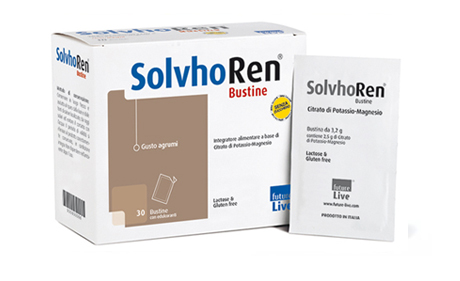
The combined Potassium-Magnesium salt is not a mixture of two separate salts but an innovative formula consisting of a single salt with a balanced ratio of Potassium : Magnesium = 6.5 : 1, in line with the body’s physiological requirements, which guarantees:
-
Greater intake of citrate compared to mixtures of individual potassium citrate and magnesium citrate salts.
-
Balanced intake of potassium and magnesium, fundamental elements for cardiac, muscular, and nervous system function.
-
Excellent absorption.
-
Excellent gastro-intestinal tolerance.
Bibliografia:
Phillips, Rebecca, et al. “Citrate salts for preventing and treating calcium containing kidney stones in adults.” Cochrane Database of Systematic Reviews 10 (2015).
Koenig, Karl, et al. “Bioavailability of potassium and magnesium, and citraturic response from potassium-magnesium citrate.” The Journal of urology 145.2 (1991): 330-334.