



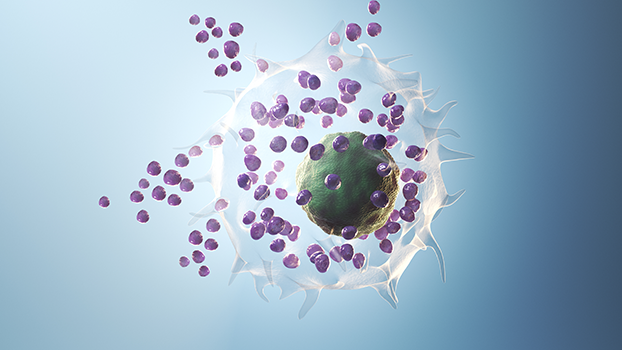
Mast cells are often described as the “sentinel cells” of our organism, but their role goes far beyond simple surveillance.
These microscopic cells, protagonists of many inflammatory processes, are emerging as key players in the understanding and treatment of chronic pain.
The ability of mast cells to influence inflammatory responses and the perception of pain makes them a particularly interesting therapeutic target for those suffering from persistent painful conditions.
Indice
What are Mast Cells?
Mast cells are specialized cells of the immune system and are found strategically positioned throughout the body, with a particular concentration in the “border” zones of our organism: the skin, the intestinal and respiratory mucosae, and the blood vessels.
Mast cells have a characteristic shape, rounded and rich in granules, which makes them easily recognizable under a microscope.
Inside their cytoplasm, they contain numerous granules rich in bioactive substances (chemical mediators), ready to be released in response to potential threats.
The role of Mast Cells in the organism
Mast cells play a crucial role in the inflammatory response.
The uniqueness of mast cells lies in their ability to move within the tissues. When they detect a potential threat, they can rapidly mobilize and release the content of their granules, a process known as degranulation, which triggers a cascade of inflammatory events.
The inflammatory cascade is a protective mechanism: when it functions correctly, it helps the organism to defend itself and repair damaged tissues. However, if this process does not stop when it should, mast cells continue to release pro-inflammatory substances, creating a cycle of persistent inflammation.
Degranulation: when mast cells activate
The degranulation process represents a key moment in mast cell activity. During this phenomenon:
- The cells release the contents of their granules
- Pro-inflammatory substances are liberated
- A cascade of biological events is triggered
- A pain response can develop
Mast Cells and Chronic Pain: a complex relationship
The excessive activation of mast cells can contribute to the development of chronic pain through several mechanisms:
- Continuous release of inflammatory mediators
- Sensitization of pain nerves
- Creation of a cycle of persistent inflammation
- Alteration of pain perception
The concept of “Mast Cell Exuberance”
Mast cell exuberance occurs when mast cells:
- Do not receive the “stop” signal
- Continue to release pro-inflammatory substances
- Keep the inflammatory process active
- Contribute to the chronicity of pain
How to control mast cell activity?
The management of mast cell activity represents a fundamental therapeutic goal in the treatment of chronic pain. There are several strategies to modulate the activity of these cells:
Modern therapeutic approaches
The most recent research focuses on molecules capable of:
- Modulating mast cell activation
- Reducing degranulation
- Controlling the release of inflammatory mediators
- Breaking the cycle of chronic pain
The role of PEA in mast cell control
Palmitoylethanolamide (PEA) emerges as a particularly interesting molecule in this context. This natural substance:
- Acts as a modulator of mast cell activity
- Helps to control inflammation
- Contributes to the reduction of chronic pain
- Does not present significant side effects
Conclusions and future perspectives
The understanding of the role of mast cells in chronic pain has opened new paths for the treatment of various painful conditions. The modern therapeutic approach increasingly focuses on strategies that can modulate the activity of these cells in a natural and safe way.