



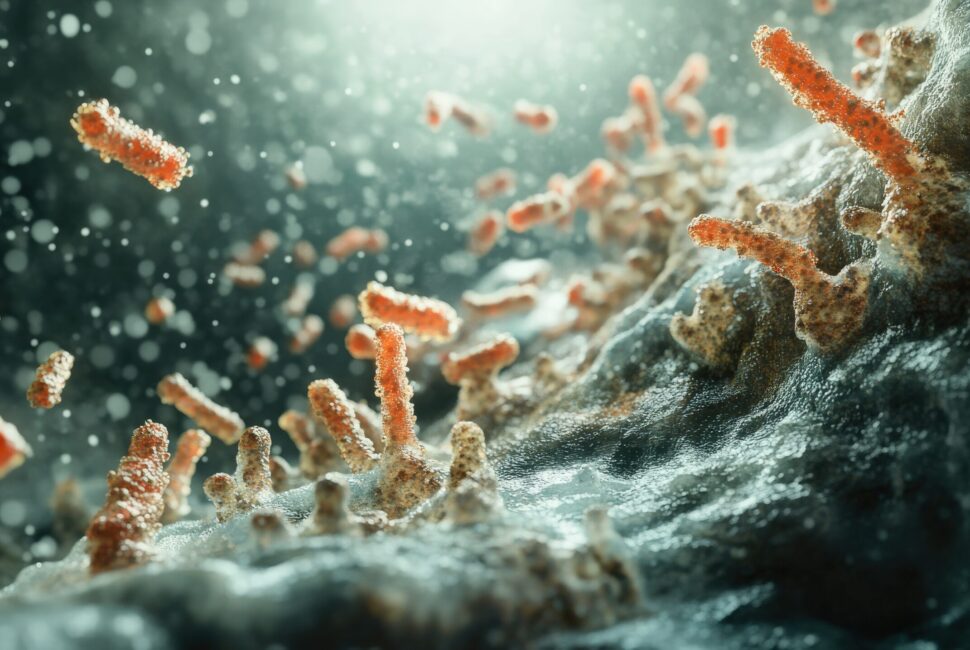
When an infection seems to resolve only temporarily and tends to recur over time, the cause is often not an incorrect therapy, but a little-known biological mechanism: biofilm.
Biofilm represents one of the primary survival strategies of bacteria and explains why many infections become persistent or recurrent, despite correct treatments.
Understanding what biofilm is is a fundamental step in comprehending why some infections are so difficult to eliminate definitively.
Indice
What is bacterial biofilm
Biofilm is a protective structure produced by bacteria. It does not consist of isolated bacteria, but of microorganisms embedded within an extracellular matrix that they themselves secrete.
This matrix is mainly composed of:
- polysaccharides
- proteins
- DNA fragments
- a large amount of water
The result is a sort of viscous film that envelops the bacteria and protects them from the external environment.
Why bacteria produce biofilm
In unfavorable conditions, such as the presence of antibiotics, the immune system response, or environmental stress, some bacteria activate biofilm production to protect themselves.
Within the biofilm, bacteria:
- are less exposed to external agents
- slow down their metabolism
- increase their probability of survival
This behavior does not make the infection more aggressive, but it makes it more difficult to eliminate.
Biofilm and resistance to treatments
One of the most critical aspects of biofilm is its ability to hinder the action of traditional treatments.
Biofilm functions as a physical barrier that reduces the effectiveness of the immune response and slows down the penetration of antibiotics, protecting bacteria even when therapy is correct.
Furthermore, within the biofilm, bacterial cells can be present in a state of quiescence, showing low sensitivity to drugs that act on active microorganisms.
To learn more, read the article Antibiotic resistance: why some infections don’t truly heal.
Why biofilm favors recurrence
When a therapy reduces free bacteria, symptoms may improve. However, if the biofilm remains intact, a portion of the microorganisms can survive.
Over time, these bacteria can reactivate and cause a new manifestation of the infection.
This mechanism is at the base of many chronic and recurrent infections and is one of the reasons why some people experience repeated episodes of the same disorder.
Biofilm as a new target
In recent years, scientific research has begun to consider biofilm as an actual therapeutic target.
Addressing the biofilm means intervening in the structure that protects the bacteria, making them more vulnerable and reducing the risk of recurrence.
This change in perspective has paved the way for new approaches, designed to complement traditional therapies in cases where biofilm plays a key role.