



Pain, especially visceral and muscular pain, is often linked to a state of persistent contraction of the smooth muscles. In these conditions, intervening only on the symptom is not enough: it is fundamental to also act on the physiological cause, namely the spasm.
Magnesium pidolate represents one of the most effective forms of magnesium in this context, thanks to its muscle-relaxing and spasmolytic action.
Why does magnesium help against pain?
Magnesium is an essential mineral involved in the regulation of neuromuscular activity. When levels are adequate:
- it contributes to the relaxation of muscle fibers
- it modulates the transmission of nerve impulses
This translates into an indirect, but extremely relevant, analgesic effect: by reducing muscle contraction, the pain is attenuated.
Magnesium pidolate: the most active form on the muscles
Not all magnesium salts are the same.
Several studies have highlighted that some carriers (such as aspartate or lactate) can reduce or cancel the spasmolytic activity of magnesium and, in some cases, even increase the contraction of smooth muscles.
Magnesium pidolate, instead, stands out because:
- it exerts a muscle-relaxing action on spontaneous contraction
- it also acts on contraction induced by drugs or external stimuli
- it maintains its biological efficacy intact at the muscular level
This makes it particularly indicated in conditions characterized by pain associated with spasm.
Experimental evidence
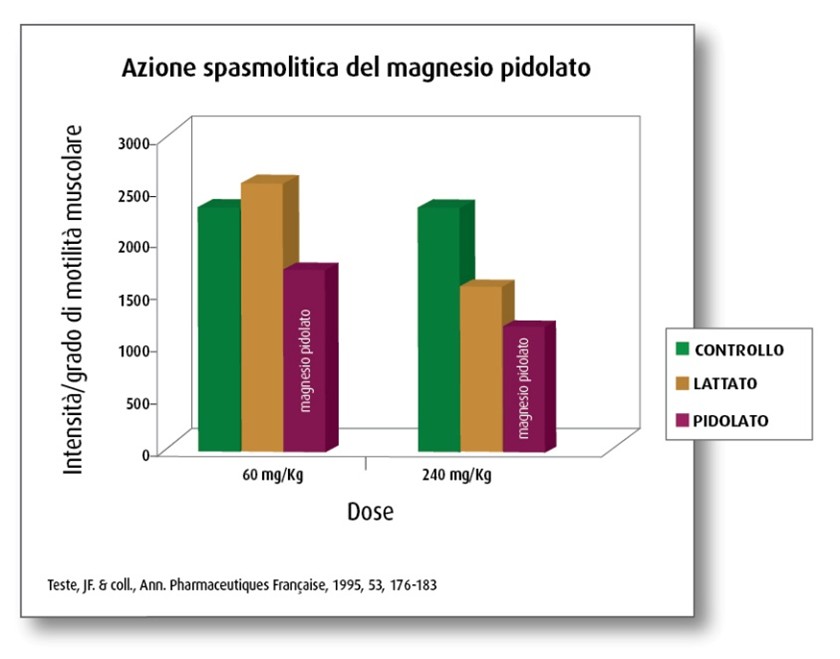
The graph shown highlights the spasmolytic action of magnesium pidolate compared with other forms of magnesium.
It is clearly observed that magnesium pidolate significantly reduces muscle motility compared to the other forms.
These data confirm that not all forms of magnesium have the same impact on the muscles, and that the pidolate is among those with the greatest muscle-relaxing activity.