




enflog® is a mixture of proteolytic enzymes developed to act in synergy and with high specificity toward protein substrates of biological interest. Recently, it has proven capable of counteracting the defense mechanisms implemented by certain bacteria, particularly biofilm formation. Its use serves as an innovative support in contexts where the biofilm represents an obstacle to the effectiveness of conventional therapies for the treatment of bacterial infections.
Thanks to its patented formulation, enflog® can act in a targeted manner on the protein substrates that make up the biofilm matrix, making bacteria more vulnerable and easier to counteract.
The role of biofilm in urogenital infections
Urogenital tract infections represent a issue of major clinical relevance, primarily due to their frequency and their tendency to recur over time.
Among the microorganisms most frequently involved, Escherichia coli (E. coli) stands out—a bacterium normally present in the intestine that can reach the urinary tract and cause infections, including recurrent cystitis and other forms of urinary tract infection.
One of the aspects that makes counteracting these infections particularly complex is the ability of certain bacteria, including E. coli, to organize themselves into protective structures called biofilms.
A biofilm is an organized biological matrix composed of different components, including proteins and other extracellular substances, within which bacteria can adhere to biological surfaces and find protection from adverse environmental conditions and the action of antimicrobial agents.
In the urogenital context, these mechanisms can contribute to bacterial persistence and the difficulty of eradicating certain infections, favoring conditions associated with recurrence.
enflog®: the enzymatic approach to bacterial biofilm
In questo contesto si inserisce la ricerca su enflog®, una miscela brevettata di enzimi proteolitici composta da bromelina, papaina e proteasi da Aspergillus oryzae.
The formulation was developed to act synergistically on protein substrates of biological interest.
Studies conducted have investigated the ability of enflog® to interfere with bacterial defense mechanisms, with a focus on biofilm formation and structure.
Interest in its application within the urogynaecological field stems precisely from the possibility of targeting the protein component of the biofilm matrix, aiming to leave bacteria more exposed and vulnerable to the action of conventional treatments.
Scientific evidence on the efficacy of enflog®
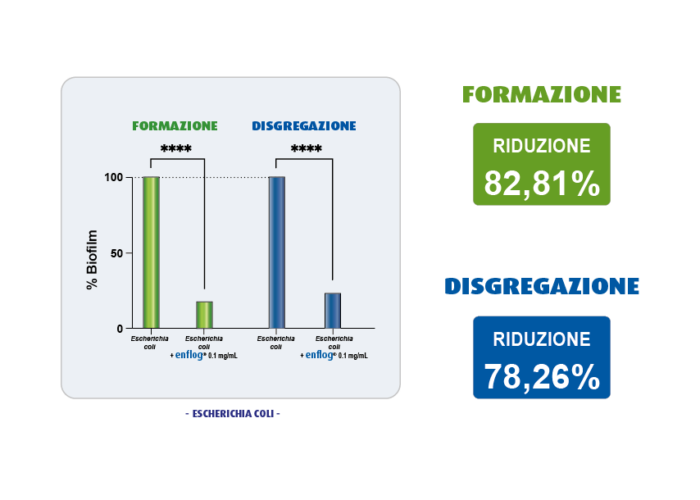
The efficacy of the enflog® enzymatic mixture is supported by scientific studies evaluating its action on bacterial biofilm, highlighting results of high statistical significance (****).
In particular, a study demonstrated that enflog® is capable of:
- reducing Escherichia coli biofilm formation by 82.81% (p<<0.0001)
- disrupting an already established biofilm by up to 78.26% (p<<0.0001) These results highlight how the enzymatic action of enflog® can intervene both in the preventive phase and on already structured biofilms, representing potential support in management strategies for bacterial infections caused by biofilm-producing microorganisms.
Related topics

Biofilm ed enzimi proteolitici: un approccio mirato alle infezioni persistenti

Biofilm di Candida: perché la candidosi tende a recidivare

Biofilm di Escherichia coli: perché le infezioni urinarie tornano

Biofilm batterico: la difesa dei batteri dagli antibiotici
