




Indice
Recurrent cystitis: the role of inflammation
In the course of recurrent cystitis, the inflammatory state at the bladder level, triggered by a bacterial infection, very often tends to persist over time, even when the bacterial component has apparently been eradicated.
This sub-chronic inflammatory state is responsible for a whole series of symptoms consisting of burning, pain, and heaviness in the bladder area that can last for quite long periods and are the cause of significant discomfort in daily life.
In these cases, the use of specific plant substances, rich in proteolytic enzymes capable of promoting a physiological anti-inflammatory and anti-edema action within the urinary system, proves useful.
In particular, Bromelain, extracted from the pineapple stem, Papain, obtained from papaya, and Fungal Protease extracted from the fungus Aspergillus oryzae, are particularly effective as they are each able to act at a specific pH level; that is, they are able to exert their action regardless of the degree of urine acidity in each individual.
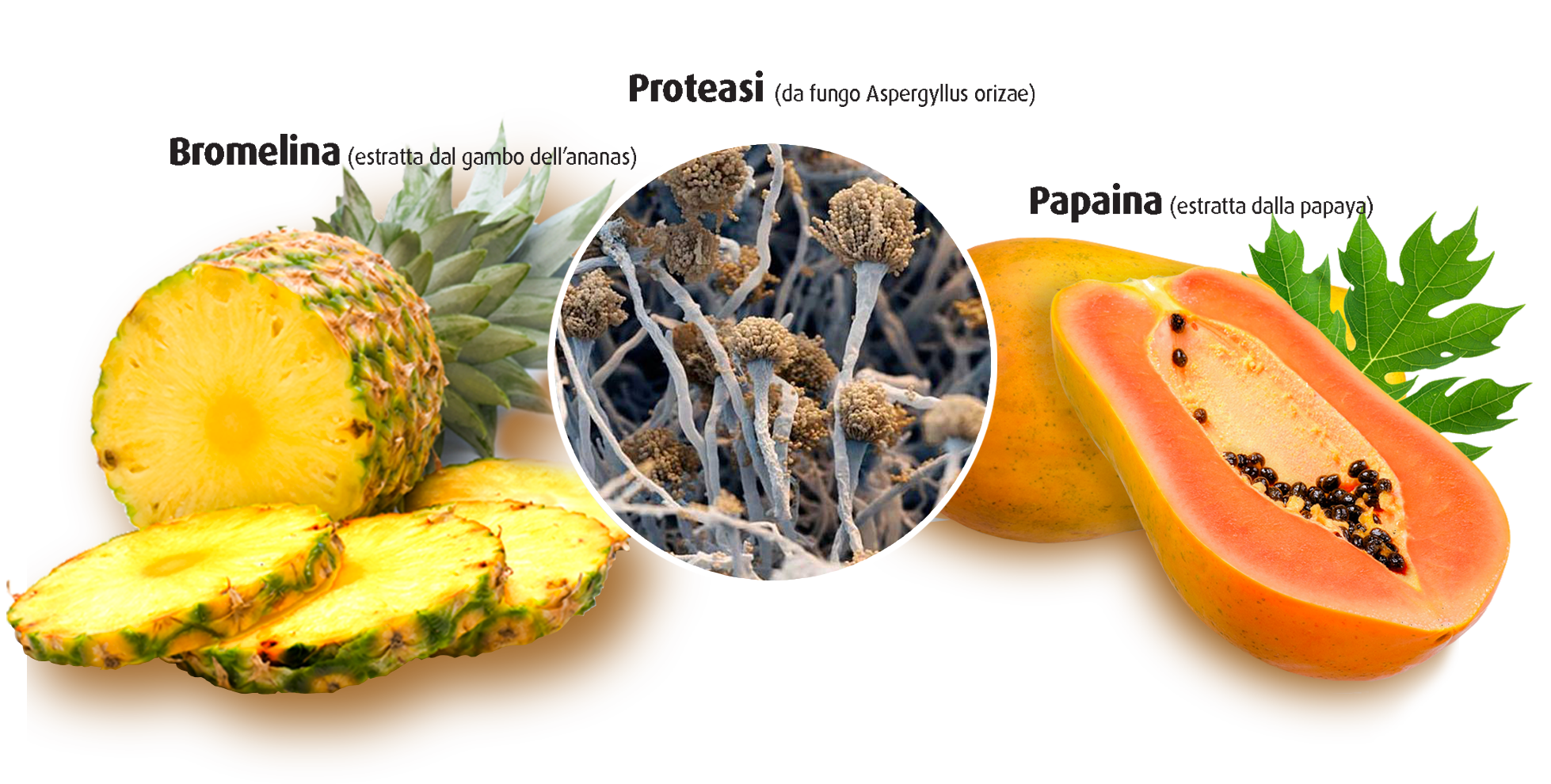
Proteolytic enzymes can be useful in the course of recurrent bacterial cystitis
Very often, the therapy for urinary tract infections utilizes antibacterial and antiseptic active ingredients, even though their effectiveness tends to decrease over time. It is therefore necessary to develop alternative treatments to improve the efficacy of the therapy. Systemic treatment with proteolytic enzymes has proven to be effective in treating various urinary tract disorders.
Clinical study on proteolytic enzymes
Sixty women aged between 19 and 45 with recurrent bacterial cystitis were studied and divided into two groups of 30 patients each: the first group received standard antibiotic therapy, while the second group took a preparation based on proteolytic enzymes in addition to the antibiotic.
The evaluation of efficacy was carried out on the 1st, 7th, and 14th day, including monitoring of symptoms, pain intensity, and laboratory tests. During the long-term follow-up (6 months after the conclusion of therapy), the relapse rate was evaluated in both groups.
Results
At the beginning of the study, all patients showed clinical and laboratory signs of cystitis. By the 14th day, there was a normalization of parameters in both groups; however, patients who were also taking systemic enzyme therapy showed faster relief of the inflammatory state (reduction in the frequency of urination, urgency, and nocturia) starting from the 7th day of treatment. During the 6-month long-term follow-up, relapses were 30% in the first group and only 13.3% in the second group.
Conclusions
The study results demonstrated the good efficacy of proteolytic enzyme therapy, which ensures a faster improvement in urinary symptoms and pain, as well as a reduction in recurrences in women with chronic recurrent bacterial cystitis.
Bibliografia
A.V. Kuzmenko et al- Systemic enzyme theraphy for treatment of women with chronic recurrent bacterial cystitis- Urologiia 2020 apr(2) :35-40